




ELCB vs RCCB: Key Differences, Which One Should You Choose in 2026?
Summary
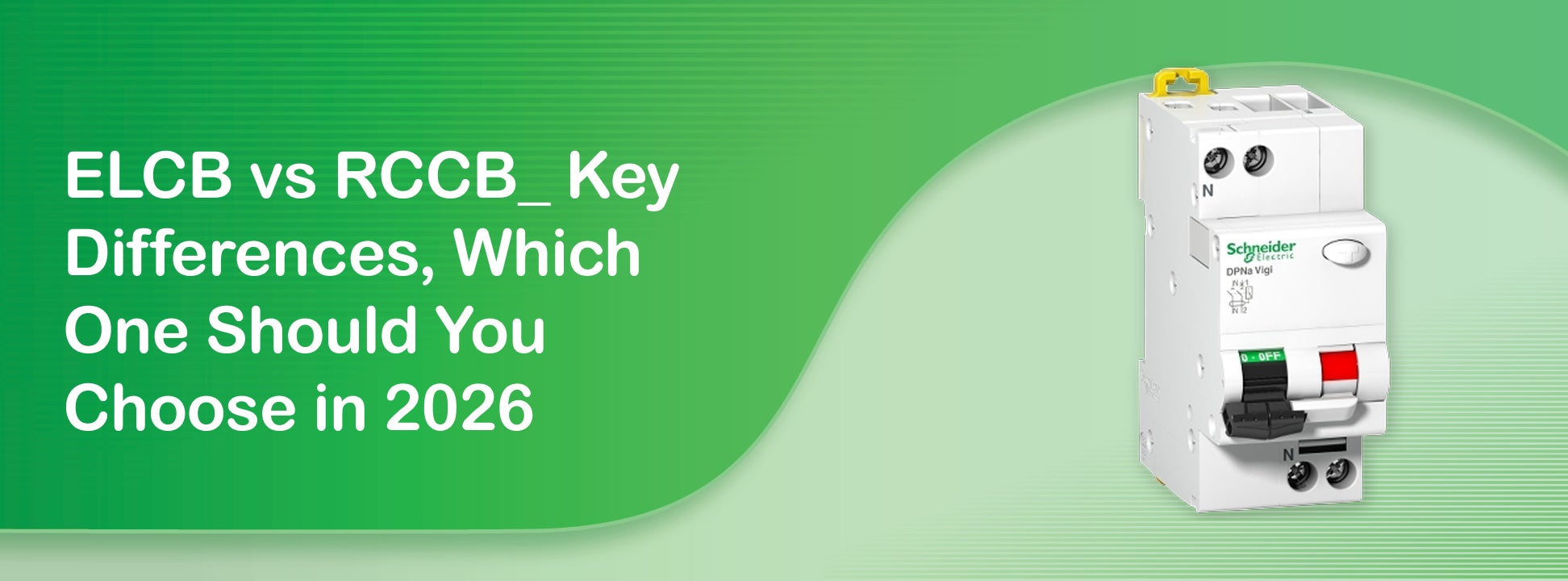
Two protection devices, similar job, very different methods. That's the short version of the RCCB and ELCB difference. This guide breaks down what is the difference between ELCB and RCCB in plain terms, covering how each device works, where each one still makes sense, and which suits a 2026 electrical system best. Whether comparing RCCB vs ELCB for a home upgrade or sourcing new RCCB switches for a panel, the answer usually comes down to sensitivity and how the fault gets detected.
Key Takeaways
• ELCB detects voltage leakage to earth, while RCCB detects current imbalance.
• RCCB tends to be more sensitive and easier to install in modern systems.
• ELCB relies heavily on a solid earth connection to work properly.
• Most new installations now favour RCCB over older ELCB technology.
• Choosing between them depends on system age, load, and required sensitivity.
Introduction
Electrical safety devices don't get much attention until something goes wrong. Then suddenly everyone wants answers fast. Two names come up constantly in this conversation, ELCB and RCCB. They sound almost interchangeable at first glance. They're not. One watches voltage, the other watches current, and that distinction changes how reliably each device catches a real fault. This guide walks through ELCB vs RCCB clearly, covering how both work, where they differ, and which one actually belongs in a modern panel heading into 2026.
What is an ELCB?
An ELCB, short for earth leakage circuit breaker, protects against faults by monitoring voltage rather than current. It sits between an electrical installation and the earth connection, watching for any voltage difference that suggests current is leaking somewhere it shouldn't.
Older buildings still lean on this technology fairly often. Voltage-operated ELCBs measure the drop across the earth wire directly, tripping once that voltage crosses a set threshold. Current-operated versions exist too, monitoring leakage current instead, though these are essentially early RCCBs by another name. What matters most with an ELCB is the earth connection itself. Without a solid, low-resistance path to earth, the device simply cannot detect a fault reliably, which is exactly why this technology has fallen out of favour in newer construction.
How Does an ELCB Work
The working principle centres entirely on voltage, not current. That single design choice shapes both the strengths and the real limitations of this older protection method.
Voltage Monitoring Basics
An ELCB constantly measures the voltage between the earthing system and true earth potential. Under normal conditions, this value stays close to zero. The moment a fault sends current through the earth wire, voltage rises noticeably. Once that rise crosses the trip threshold, the device disconnects the circuit almost immediately.
Dependence on Earth Wire Integrity
This is where things get tricky. A corroded, loose, or poorly maintained earth connection throws off the entire detection process. Since the device relies entirely on measuring earth potential, any degradation in that wire reduces reliability. Over time, in older installations, this becomes a genuine weak point in the system.
Typical Trip Response
ELCB response times tend to run slower compared to current sensing alternatives, largely due to how voltage-based detection works. This isn't necessarily dangerous on its own, but it does mean ELCBs generally offer less margin during a fast-developing fault than more modern devices designed around current imbalance instead.
What is an RCCB?
An RCCB, or residual current circuit breaker, takes a different approach entirely. Rather than watching voltage, it continuously compares the current flowing through the live wire against the current returning through neutral.
Under normal operation, those two values should match exactly, creating a balanced magnetic field inside the device's core transformer. The instant someone touches a live component, or insulation fails somewhere in the circuit, that balance breaks. Current escapes through an unintended path, often through a person's body toward earth, and the RCCB senses this imbalance within milliseconds. Because it doesn't depend on measuring earth voltage directly, an RCCB works reliably even in installations where the earth connection isn't perfect, which explains much of its growing popularity across modern residential and industrial systems alike.
How Does an RCCB Work
The core mechanism revolves around current comparison rather than voltage sensing, a difference that gives RCCB devices a meaningful edge in speed and reliability.
The Core Transformer Principle
A toroidal core transformer encircles both live and neutral conductors inside the device. Their magnetic fields cancel out completely when current stays balanced. Any leakage disrupts that cancellation, generating a differential field the transformer detects instantly, triggering the trip mechanism well before dangerous current levels build up.
Sensitivity and Rated Current
RCCBs come rated at different sensitivity levels, commonly 30mA, 100mA, and 300mA, chosen based on the application. Lower thresholds suit personal shock protection in homes, while higher ratings sometimes fit industrial circuits where nuisance tripping needs minimising without sacrificing meaningful fault protection.
Pole Configuration
RCCB switches come in two pole and four pole variants. Two pole units suit single phase household circuits, while four pole versions handle three phase industrial systems, monitoring every phase and the neutral conductor together for any sign of current imbalance across the full system.
RCCB and ELCB Difference
Comparing these two devices side by side clears up a lot of confusion fast. The RCCB and ELCB difference isn't just technical trivia either, it directly affects how reliably a system protects people during a real fault.
Detection Method
RCCB monitors current imbalance between live and neutral wires directly. ELCB instead watches voltage differences relative to earth. This fundamental difference in approach explains nearly every other distinction between the two devices, from installation requirements through to overall reliability in modern electrical systems.
Earth Connection Requirement
RCCB does not require a functioning earth connection to operate correctly, since it never measures earth voltage in the first place. ELCB depends entirely on one. A degraded or missing earth wire renders an ELCB essentially useless, while an RCCB continues working regardless.
Sensitivity Levels
RCCB devices generally offer finer sensitivity, catching smaller leakage currents that older ELCB technology often misses entirely. This matters increasingly as homes fill with electronics producing subtle leakage patterns that voltage-based detection simply wasn't designed to catch reliably.
Installation Complexity
Installing an RCCB tends to be simpler, requiring one fewer critical wire consideration compared to ELCB setups. ELCB installation demands careful attention to earthing integrity from the outset, adding complexity and cost that many modern installers now prefer to avoid entirely.
Regulatory Trends
Most current electrical codes now favour RCCB installations for new builds and major renovations. ELCB technology persists mainly in older buildings that haven't been upgraded yet. This shift reflects growing confidence in current-based detection over the older voltage-based method across the industry broadly.
| Feature | RCCB | ELCB |
|---|---|---|
| Full Form | Residual Current Circuit Breaker | Earth Leakage Circuit Breaker |
| Detection Method | Compares live and neutral current for imbalance | Measures voltage between the earthing system and true earth |
| Earth Connection Needed | Not required to function | Required, and central to how it detects faults |
| Sensitivity | Higher, detects smaller leakage currents | Lower, may miss subtle leakage |
| Response Speed | Fast, typically within milliseconds | Slower, dependent on voltage build-up |
| Trip Threshold | Adjustable, common ratings of 30mA, 100mA, and 300mA | Often fixed, based on earth voltage limits |
| Pole Configuration | Two-pole for single-phase, four-pole for three-phase systems | Typically wired through the earth conductor |
| Suited Applications | Homes, electronics, EV charging, and industrial motors | Older buildings with a reliable, well-maintained earth path |
| Installation Complexity | Simpler, with no dependency on earth wire condition | More involved, as earth integrity must be verified first |
| Maintenance Needs | Low, periodic test button checks are usually sufficient | Higher, as the earth connection requires regular inspection |
| Impact of Poor Earthing | Continues to function normally | Reliability drops significantly and may fail to trip |
| Regulatory Trend | Increasingly mandated in new builds and renovations | Being phased out in most modern electrical codes |
| Typical Cost | Moderate, varies by sensitivity and pole count | Often lower upfront, though earthing work adds expense |
| Best Suited For | New installations and system upgrades | Legacy systems where full rewiring is not yet practical |
Which is Better ELCB or RCCB
There's no universal answer here, honestly. Which is better ELCB or RCCB depends heavily on the system in question, its age, and what level of sensitivity the application genuinely requires.
When to Choose ELCB
ELCB still makes sense in older buildings with an already solid, well-maintained earth connection, where replacing the entire panel isn't practical right now. It suits budget-limited upgrades in legacy systems, though most electricians now recommend transitioning toward RCCB technology whenever a fuller renovation becomes feasible down the line.
When to Choose RCCB
For nearly every new installation, RCCB is the stronger choice. It doesn't depend on earth wire condition, responds faster to genuine faults, and handles the leakage patterns produced by modern electronics far more reliably. ELCB vs RCCB which is better becomes an easy call once earth reliability enters the equation.
Conclusion
The RCCB vs ELCB debate really comes down to detection method and reliability in the end. ELCB served its purpose for decades, but RCCB's current-based approach simply performs better across most modern applications, particularly where earth connections aren't guaranteed to stay in perfect condition. Anyone upgrading a panel or sourcing new RCCB switches can find a reliable range of protection devices through the Schneider Electric eShop.
FAQs
Q1. Can an ELCB be directly replaced with an RCCB in an existing panel?
Usually yes, though wiring adjustments may be needed. A licensed electrician should verify compatibility before swapping either device.
Q2. Are ELCBs still manufactured and sold today?
Voltage-operated ELCBs have become rare in most markets, largely replaced by RCCB technology, though some legacy stock remains available for repairs.
Q3. Does an RCCB protect against short circuits or overloads?
No, an RCCB only detects earth leakage current. Overload and short circuit protection require a separate miniature circuit breaker installed alongside it.
Q4. How often should an RCCB or ELCB be tested?
Monthly testing using the built-in test button is generally recommended, ensuring the device still trips correctly before a real fault occurs.
Q5. Is a combined RCBO a better option than either device alone?
An RCBO combines overload and leakage protection in one unit, offering convenience, though it doesn't fundamentally change the RCCB versus ELCB detection debate.
Comments