



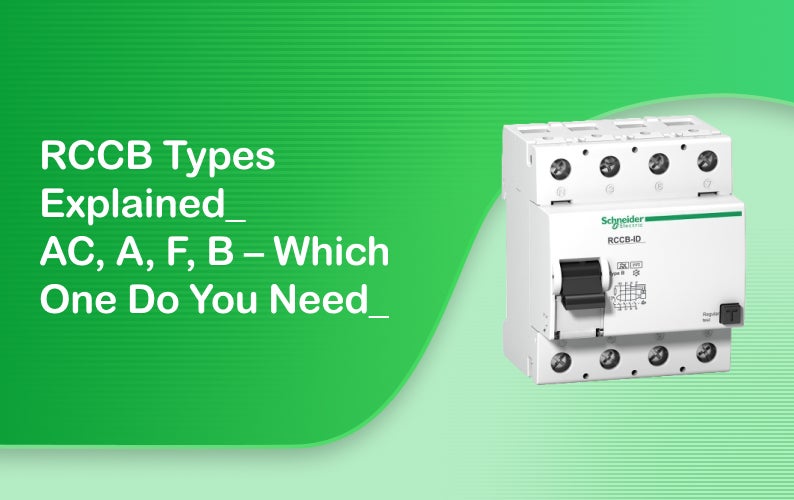
RCCB Types Explained: AC, A, F, B – Which One Do You Need?
Summary
Not every RCCB protects against the same kind of fault. That's the part most people miss. This guide covers the main types of RCCB on the market, breaking down RCCB types by the current waveform each one detects. It looks at RCCB specifications, compares different types of RCCB side by side, and answers the question buried in every panel upgrade: which RCCB switches actually suit a modern home, an EV charger, or a factory floor.
Key Takeaways
• RCCBs detect earth leakage current and cut power before it causes harm.
• Type AC only catches standard sine wave leakage, nothing more.
• Type A adds protection against pulsating DC from electronics.
• Type F handles variable frequency loads like heat pumps.
• Type B offers full protection, including smooth DC from EV chargers.
Introduction
A circuit breaker trips on overload. An RCCB does something different entirely. It watches for current sneaking off to earth, the kind that causes shocks rather than fires. Simple enough, on the surface. But modern homes run on electronics that old protection devices were never built to see. Laptops, LED drivers, EV chargers, they all leak current in shapes a basic breaker can't detect. This guide breaks down what an RCCB actually does, how the main types differ, and which one belongs on a given circuit.
What is an RCCB?
An RCCB, short for residual current circuit breaker, monitors the current flowing into and out of a circuit. Under normal conditions, what goes in equals what comes out. The moment a mismatch appears, current is leaking somewhere it shouldn't, often through a person. The RCCB senses that imbalance and cuts power almost instantly.
This matters more than people assume. A frayed cable, a damaged appliance, even a bit of moisture in the wrong spot, any of these can create a leakage path. Without an RCCB in place, that leakage might go completely unnoticed until someone gets shocked. With one installed, the circuit shuts down before real harm happens. Not every RCCB behaves identically, though. Different types of RCCB respond to different current shapes, and picking the wrong one leaves gaps in protection that aren't obvious until something goes wrong.
RCCB Working Principle
Underneath the casing, the mechanism is elegantly simple. It compares two currents constantly, watching for the tiniest imbalance, then reacts in a fraction of a second once something looks off.
Sensing the Imbalance
Inside the device sits a small toroidal coil, with both the live and neutral wires passing through it. Under balanced conditions, their magnetic fields cancel out completely. The instant current leaks to earth, that balance breaks. The coil detects the resulting magnetic field and triggers the tripping mechanism almost instantly, often within milliseconds.
The Trip Mechanism
Once imbalance is detected, a small relay activates a spring-loaded mechanism, physically disconnecting the circuit. This happens fast enough to prevent serious injury in most cases, though the exact threshold depends on the rated sensitivity of the specific device. Higher sensitivity units trip at lower leakage levels, offering tighter protection for sensitive applications.
Testing the Device
Every RCCB includes a test button, and pressing it manually introduces a small artificial imbalance. If the device is working correctly, it trips immediately. Skipping this simple test, even once every few months, is a common oversight. A faulty RCCB that never trips offers no protection at all, despite sitting right there in the panel.
RCCB Specifications
Reading a datasheet properly matters more than most people realise. RCCB specifications cover far more than just amperage, and overlooking the finer details can leave a circuit technically protected but practically vulnerable.
Rated Current and Sensitivity
Rated current defines the maximum load the device can handle without tripping under normal conditions. Sensitivity, measured in milliamps, defines how small a leakage current triggers a trip. Residential circuits typically use 30mA sensitivity for shock protection, while higher thresholds sometimes suit specific industrial equipment where nuisance tripping needs to be minimised.
Number of Poles
RCCBs come in two pole and four pole configurations, depending on whether the circuit is single phase or three phase. Two pole units handle standard household circuits. Four pole versions suit three phase industrial setups, monitoring all phase and neutral conductors simultaneously for a leakage imbalance across the entire system.
Breaking Capacity
Breaking capacity indicates how much fault current the device can safely interrupt without damage to itself. This rating matters particularly in industrial settings, where fault currents run considerably higher than in a typical home. Choosing an RCCB switches option with inadequate breaking capacity risks device failure exactly when protection matters most.
Types of RCCB
Labels on a shelf can look nearly identical, yet the differences between them matter enormously. Different types of RCCB exist specifically because modern electrical loads no longer behave like the simple resistive devices these breakers were originally designed around.
Type AC RCCB
Type AC is the oldest design, detecting only standard sinusoidal AC leakage. It suits simple resistive loads like immersion heaters or older incandescent lighting. Modern electronics, however, sit outside its detection range entirely. Many countries are phasing Type AC out of residential use for exactly this reason.
What is Type A RCCB
What is type a RCCB, in practical terms? It's the modern baseline, detecting everything Type AC catches plus pulsating DC leakage from rectifiers. Nearly every household appliance today, laptops, washing machines, LED drivers, produces this kind of leakage. Most general socket circuits now default to Type A as standard practice.
Type F RCCB
Type F builds on Type A, adding tolerance for mixed frequency signals produced by variable speed drives. Heat pumps and modern air conditioners often trip standard Type A devices unnecessarily during startup. Type F ignores that harmless startup noise while still catching genuine faults across a wider frequency range.
Type B RCCB
Type B provides the broadest coverage available, including smooth DC leakage from EV chargers, solar inverters, and battery systems. Standard sensing coils simply cannot detect flat DC current, which makes RCCB type b mandatory wherever these loads exist. It costs more, but for certain applications there's genuinely no substitute.
RCCB Type AC vs Type A
Comparing RCCB type AC vs Type A comes down almost entirely to one thing: what kind of current leakage each device can actually detect once installed in a working circuit.
| Feature | Type AC | Type A |
|---|---|---|
| Detects Sine Wave AC | Yes | Yes |
| Detects Pulsating DC | No | Yes |
| Suited For | Heaters, old lighting | Sockets, electronics |
| Modern Compliance | Being phased out | Widely mandated |
| Typical Cost | Lower | Moderate |
RCCB Type A vs Type B
The gap between RCCB type a vs type b comes down to smooth DC detection specifically, a difference that matters enormously wherever EV charging or solar generation enters the picture.
| Feature | Type A | Type B |
|---|---|---|
| Detects Pulsating DC | Yes | Yes |
| Detects Smooth DC | No | Yes |
| Suited For | Home sockets, PCs | EV chargers, solar, UPS |
| Sensor Technology | Standard coil | Coil plus fluxgate sensor |
| Typical Cost | Moderate | Higher |
Conclusion
Matching the breaker to the load is really what this whole decision comes down to. Type AC covers the basics, Type A handles most modern homes, Type F suits variable speed equipment, and Type B remains essential wherever EVs or solar systems are involved. Anyone reviewing a panel or planning an upgrade can find a reliable range of RCCB switches and related protection devices through the Schneider Electric eShop.
FAQs
Q1. Can an RCCB be installed alongside a standard circuit breaker?
Yes, and this combination is common. The circuit breaker handles overload and short circuit protection, while the RCCB specifically covers earth leakage faults.
Q2. How long does a typical RCCB last before needing replacement?
Most units last well over a decade with regular testing, though mechanical wear or environmental exposure can shorten that lifespan considerably in harsher settings.
Q3. Does an RCCB protect against overload or short circuit faults?
No, an RCCB only detects earth leakage current. Overload and short circuit protection require a separate device, usually a miniature circuit breaker.
Q4. Why might an RCCB trip repeatedly without an obvious fault present?
Nuisance tripping often stems from accumulated harmless leakage across many devices, or from installing the wrong RCCB type for the connected load.
Q5. Is a professional electrician required to install or upgrade an RCCB?
Generally yes, since incorrect wiring or an unsuitable device selection can leave a circuit either falsely protected or prone to constant nuisance tripping.
Comments