





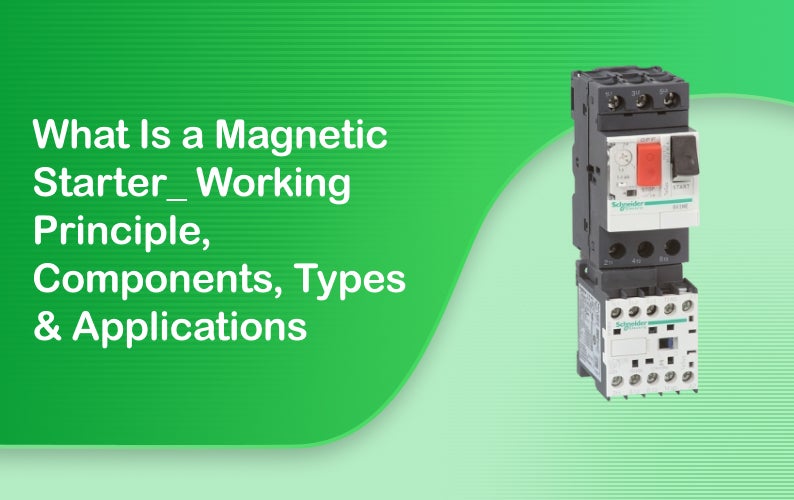
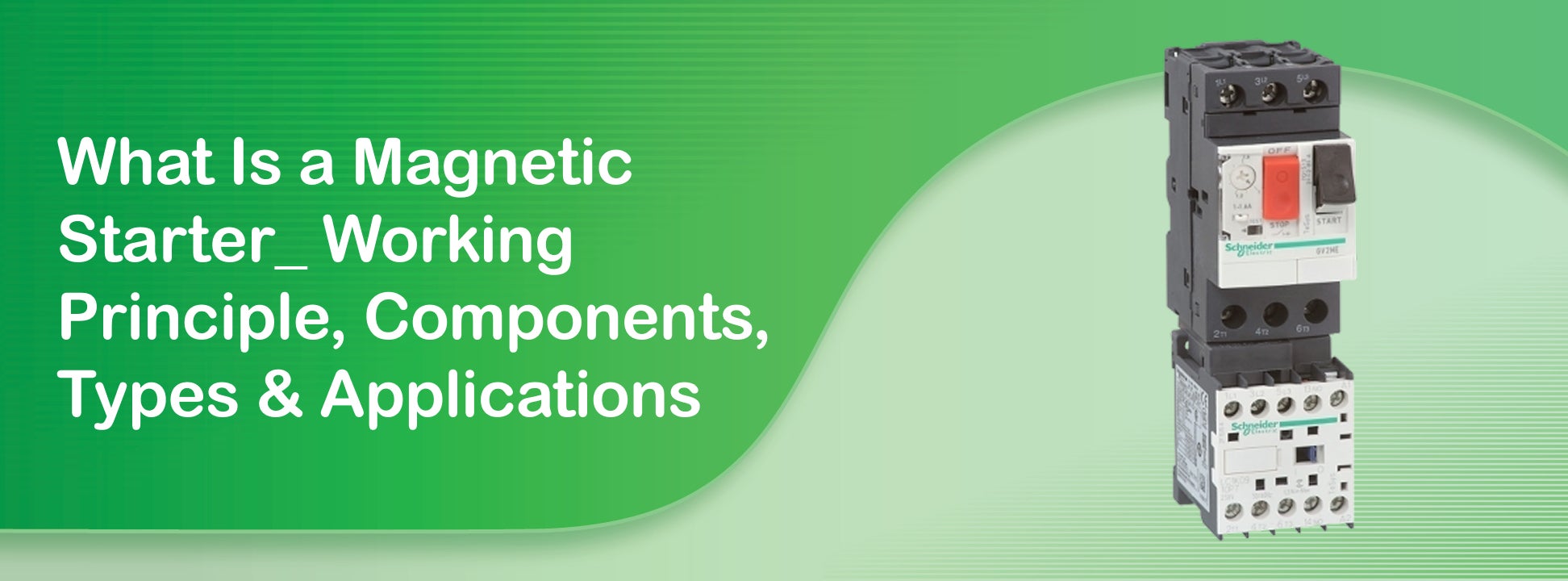
What is a Magnetic Starter? Working Principle, Components, Types & Applications
Summary
A magnetic starter is a switching device. It starts, stops, and protects electric motors. The starter guards against overload and low voltage. Anyone asking what is a magnetic starter really wants to know one thing: how does a motor turn on safely, without someone standing at the panel all day? A magnetic starter answers that. Built around a contactor and an overload relay, a three phase magnetic starter forms the backbone of motor control in Industrial Automation. It keeps pumps, compressors, and conveyors running across factories and plants.
Key Takeaways
• A magnetic starter pairs a contactor with an overload relay. Together, they switch and protect motors.
• The coil, contacts, and overload relay work as a team. They deliver power. They cut it off fast when something goes wrong.
• Under-voltage protection stops motors from restarting on their own. This happens once power comes back after an outage.
• The magnetic starter vs contactor question usually comes down to one thing: built-in overload protection.
• Wiring splits into two parts. There is a power circuit. There is a control circuit. Each does its own job.
• Direct-on-line, star-delta, and reversing setups suit different motor sizes and starting needs.
• Applications range from water pumps to compressors, HVAC blowers, conveyors, and machine tools.
Introduction
Walk into almost any factory or pump house. There is a good chance a magnetic starter sits quietly behind a panel door, doing its job. It is not flashy. Nobody talks about it much. But without it, motors would need constant watching, or they would risk burning out fast. This article covers the working principle. It covers the magnetic motor starter components inside the box. The guide also covers common wiring layouts too, and where these devices show up on the factory floor. Along the way, the magnetic starter vs contactor question comes up, since people mix the two up often.
What is a Magnetic Starter?
At its core, a magnetic starter is a switch. It uses an electromagnet to open and close the contacts that feed power to a motor. Press the start button. Current flows into a coil. The coil pulls the contacts shut, and the motor spins up. Let go of the button, and the contacts stay closed. A holding circuit takes over. This same device also watches the motor all the time. It stays ready to cut power the moment it senses trouble. That mix of switching and protection is what sets it apart from a plain switch.
A magnetic starter is an electromagnetically operated switch. It is built to safely start, stop, and protect electric motors from overload and under-voltage conditions.
Understanding How Does a Magnetic Starter Work
Before diving into parts, look at the bigger picture first. Understanding how does a magnetic starter work comes down to one simple chain reaction. A small control signal triggers a much bigger electrical event downstream. Everything else- the coil, the contacts, the protection circuit- exists to manage that reaction safely. The sections below walk through each stage, one at a time.
Electromechanical Operation Sequence
How does a magnetic starter work? First, the coil energizes when someone presses the start button. This draws a small control current. Second, that energized coil builds an electromagnetic force. It is strong enough to pull the movable armature toward it. Third, this movement causes contact closure. The power circuit contacts join together. Finally, power delivery to motor windings begins, and the motor starts turning almost at once. Each stage takes a fraction of a second. The sequence never skips a step.
Under-Voltage (Low Voltage) Protection
Here is something worth pausing on. When mains voltage dips or disappears, the electromagnetic coil cannot hold enough pull. So the contacts drop out on their own. That sounds small, but it stops a real danger: a motor restarting on its own the second power returns, with nobody around to expect it. Instead, an operator must press start again once things are safe. This drop-out behaviour is one of the most underrated safety features in the whole design.
Overload Protection Mechanism
Two main methods handle overload sensing. Thermal bimetallic strips bend as current heats them. Once they bend far enough, they trip the control circuit and break the holding path. Electronic solid-state sensing works differently. It measures current directly and triggers a trip state through internal logic, not physical bending. Thermal types cost less and stay simple. Solid-state types offer finer accuracy, often with adjustable trip settings. Either way, the goal stays the same: stop the motor before overcurrent cooks the windings.
Essential Magnetic Motor Starter Components
Open the enclosure, and the magnetic motor starter components inside are easy to spot once you know what to look for. Nothing about the magnetic starter wiring diagram is mysterious. A contactor handles the heavy switching. A coil supplies the magnetic pull. Contacts make and break the circuit. An overload relay watches current levels. Arc chutes tame the sparks. Pushbuttons give operators manual control. Once you understand what each piece does, troubleshooting feels far less intimidating. Most faults trace back to just one or two worn parts.
Contactor Assembly
The contactor assembly forms the main body of the starter. It houses the moving parts that do the actual switching. It bolts onto the panel and carries full motor current through its main contacts. Inside, spring mechanisms snap the contacts back open the instant the coil de-energizes. Manufacturers rate contactors by current capacity and duty cycle. So picking the right assembly for a motor's horsepower matters more than most people assume when they spec a panel.
Electromagnetic Coil
The electromagnetic coil sits at the heart of the whole system. Wound copper wire, once energized, builds the magnetic field that pulls the armature and closes the contacts. Coils come rated for set voltages, commonly 24V, 110V, or 415V, depending on the control circuit design. A coil that hums loudly or runs hot usually points to a voltage mismatch. It could also mean a mechanical block is stopping full contact closure. Both are worth checking early during fault diagnosis.
Stationary and Movable Contacts
Stationary contacts stay fixed to the contactor body. Movable contacts travel with the armature to complete or break the circuit. Both are typically made from silver alloy. This resists pitting and keeps resistance low, even after thousands of switching cycles. Over time, though, contacts do wear down from arcing. A technician can usually spot this just by checking for pitting or discolouration on the contact surface during routine maintenance.
Overload Relay (OLR)
The overload relay sits just past the contactor. It watches current draw across all three phases, all the time. If current climbs past the set limit for too long, the OLR trips. This breaks the holding coil circuit and stops the motor before real damage happens. Most overload relays include a manual reset button and an adjustable dial. This lets technicians tune the trip point to match the motor's actual full-load current rating.
Arc Chutes
Every time contacts open under load, a small arc forms briefly. Arc chutes exist to manage that arc. They contain and put out the spark fast, protecting the contacts and nearby equipment from damage. Without arc chutes, repeated switching would wear down contact surfaces much faster. It could even raise the fire risk inside a panel. It is a small part, but it quietly does a lot of unglamorous, essential work.
Reset Pushbuttons
Reset pushbuttons give operators a fast way to restore the circuit after an overload trip. Nobody needs to open the panel or call maintenance for this. Pressing reset clears the tripped state on the overload relay, as long as the fault behind it is actually fixed. Some starters combine reset with the stop button. Others keep it separate. Either way, this small control speeds up day-to-day operation for plant staff.
Types of Magnetic Starters
Not all starters are built the same way. Each type suits a different motor size, load pattern, or starting need. Knowing the differences helps when choosing the right one for a panel. Below are the main types found across factories and plants today.
Direct-On-Line (DOL) Starter
This is the simplest type. It connects the motor straight to full supply voltage the instant it starts. There is no step-down phase, no ramp-up. Current and torque both spike hard for a second or two. This works well for small motors, usually under 5 HP, where the inrush current stays manageable. For anything larger, that sudden spike can strain the supply and stress the motor windings.
Star-Delta Starter
This type reduces the initial current spike by starting the motor in star configuration first. Once the motor picks up speed, it switches to delta for full running voltage. The switch happens automatically, usually through a timer. It suits medium and large motors, where full-voltage starting would draw too much current. Slightly more wiring is involved than DOL, but the payoff is smoother starts and less strain on the supply.
Reversing Starter
A reversing starter uses two contactors instead of one. Each contactor wires two of the three phases in a different order. Swapping the order reverses the motor's rotation direction. Operators can switch between forward and reverse with a simple button press, without touching any wiring. This type shows up often on conveyors, hoists, and machine tools, where direction needs to change during normal operation.
Auto-Transformer Starter
This type uses a transformer to reduce voltage during startup, rather than rewiring the motor windings like star-delta does. It offers finer control over the starting voltage, often with multiple tap settings to choose from. Larger motors, especially in pumping stations and heavy industrial settings, often use this type when a smoother, more adjustable start is needed. It costs more than star-delta but gives better control.
Two-Speed (Multi-Speed) Starter
This type lets a single motor run at two or more distinct speeds, using separate winding connections inside the motor itself. Switching between speeds happens through separate contactor sets, each wired to a different winding configuration. Fans, blowers, and some pumps use this setup often, since they need a slow speed for light loads and a faster one when demand rises, all from one motor.
Common Industrial Applications
Magnetic starters show up wherever a motor needs reliable, protected switching. The range of uses is genuinely broad. Applications with real overload risk almost always need the extra protection a starter gives over a bare contactor.
Water Pumps
Pump motors run for long stretches, often unattended, which makes overload protection essential. A magnetic starter shuts the pump down if it runs dry or draws abnormal current, preventing burnout before anyone notices. Under-voltage protection matters too, since pumps in remote locations often face unstable supply. Treatment plants and borewell systems lean on this reliability daily.
Air Compressors
Compressors cycle on and off constantly to maintain pressure, which stresses motor windings over time. A magnetic starter handles this frequent switching without wearing out quickly, while the overload relay guards against current spikes from repeated starts. Workshops and packaging lines depend on compressors that start reliably, cycle after cycle, without supervision.
Industrial HVAC Blowers
Large buildings need continuous airflow, and blower motors often run for hours without a break. A magnetic starter keeps these motors protected during long duty cycles, tripping before heat buildup damages the windings. Remote control matters here too, since building management systems often start and stop blowers automatically, without anyone at the panel.
Conveyor Systems
Conveyors in warehouses need dependable start-stop control across long runs, often triggered remotely from a control room. A magnetic starter allows this automation while protecting the motor from jams or sudden load spikes, common when material backs up on the belt. Reversing versions are common too, letting operators clear blockages without manual rewiring.
Magnetic Starter vs Contactor
A magnetic starter vs contactor comparison comes down to one core difference. A contactor simply switches power on and off, nothing more. A magnetic starter does that too, but adds an overload relay, guarding the motor from sustained overcurrent a bare contactor would let pass through unchecked.
| Feature | Contactor | Magnetic Starter |
|---|---|---|
| Basic function | Switches power on and off | Switches power and protects the motor |
| Overload protection | Not included | Built in, via the overload relay |
| Typical use | Lighting, heating, simple loads | Motor-driven equipment |
| Under-voltage drop-out | Yes, but no protection logic attached | Yes, paired with overload tripping |
| Cost | Lower | Slightly higher, due to added protection |
| Common panel role | Standalone switching device | Complete motor control unit |
Conclusion
A magnetic starter earns its place in almost every industrial panel. Why? Because it does two jobs at once: it switches the motor, and it protects it. From the coil and contacts to the overload relay and arc chutes, every part inside the box exists to keep motors running when they should, and stop the instant something goes wrong. Whether the job calls for a simple direct-on-line setup or a full three-phase star-delta arrangement, knowing the wiring and the parts makes specifying, installing, and fixing these devices far less daunting. For panels, contactors, overload relays, and other motor control gear, the Schneider Electric eShop offers a solid range worth checking when sourcing parts for a new or upgraded setup.
FAQs
Q1. Can a magnetic starter be used with a variable frequency drive (VFD)?
Yes, though it usually works as a bypass or isolation device, not the main speed control. Some panels wire a magnetic starter ahead of a VFD for maintenance isolation. It can also serve as a backup run mode if the drive needs servicing.
Q2. How long does a typical magnetic starter last before it needs replacing?
Most units last several years under normal duty. Lifespan depends a lot on switching frequency and load conditions. Contacts and coils tend to wear out first, and technicians can often replace them alone, without swapping the whole unit.
Q3. What size magnetic starter does a specific motor need?
Sizing depends on the motor's full-load current rating, not just its horsepower. Manufacturers publish selection tables. These match contactor and overload relay ratings to specific motor current ranges. An undersized unit risks nuisance tripping or contact damage.
Q4. Is it safe to bypass an overload relay temporarily?
No. Bypassing overload protection removes the safeguard that stops winding damage from sustained overcurrent. Even a brief bypass during troubleshooting carries real risk. It should only happen under close supervision, with the motor watched the whole time.
Q5. Do magnetic starters require regular maintenance?
Yes. Periodic checks help catch pitted contacts, loose terminals, or coil wear before they cause a failure. A simple visual check and terminal tightening every few months goes a long way toward avoiding surprise downtime.
Comments